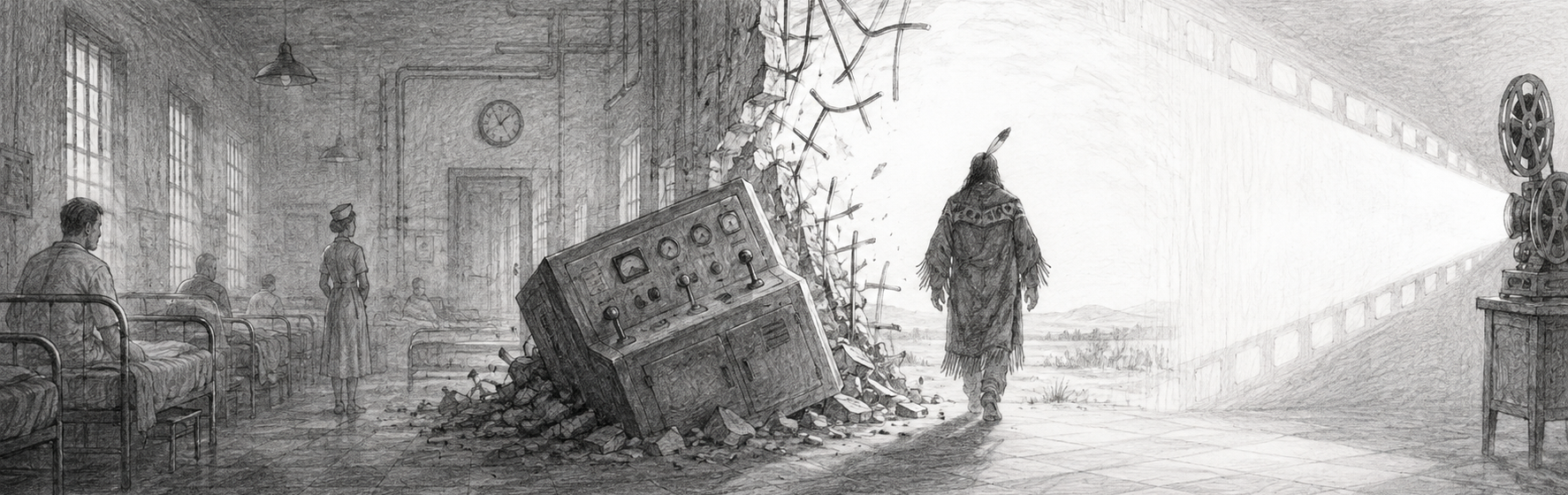
Last New Year, my beloved wife gave me the book “One Flew Over the Cuckoo’s Nest” by Ken Kesey as a gift. At that time, I had just broken my two‑year book‑free streak and devoured the novel over the holiday weekend. The lingering aftertaste lingered on the tip of my tongue every day of the past year. Partly because I knew about the 1975 film adaptation, in which Jack Nicholson played the lead role, but I hadn’t found the time or the mood to watch it.
Although the film adaptation is already in its fifth decade, I still hadn’t become acquainted with it until recently. A small gestalt was completed by chance earlier this year, when the cinema offered a screening of the restored version of the film in the original language with subtitles.
The film adaptation turned out to be simpler in its aspects than the original. As is customary, to suit the format and limited time, many plot details were changed or completely omitted. If I had watched the film before reading the original source, I would have been completely at a loss as to the cause of the central conflict in the plot: its presentation in the film seemed blurred, unfocused, and even deliberately stretched out.
The viscous and drawn‑out atmosphere of the clinic, described in the book through the words of the Leader, was lost. And the ending was completely devalued, practically stripping the entire work of its meaning. In the book, it is stunningly powerful and inspiring. You understand that it wasn’t all in vain, that McMurphy, both in life and in “death,” inspired the other patients, giving them the strength to keep living and to find their place in the world. In the film, everything remains as it was; only the Chief finally lifted the cabinet in the shower and knocked out the window with it, but his role in the film was cut so much that this event doesn’t evoke any particular emotions.
In conclusion, I can say that, despite the plot’s incompleteness and the devalued ending, I liked the adaptation — both visually and in terms of the actors’ performances. Watching it on the big screen played a role in this, creating an unusual but pleasant atmosphere for watching such a film. And, bearing the above in mind, if we consider the film adaptation as a separate work from the novel (and that’s what we should do in most film adaptations), I can recommend it to those who, like me, for some reason haven’t yet read the book.