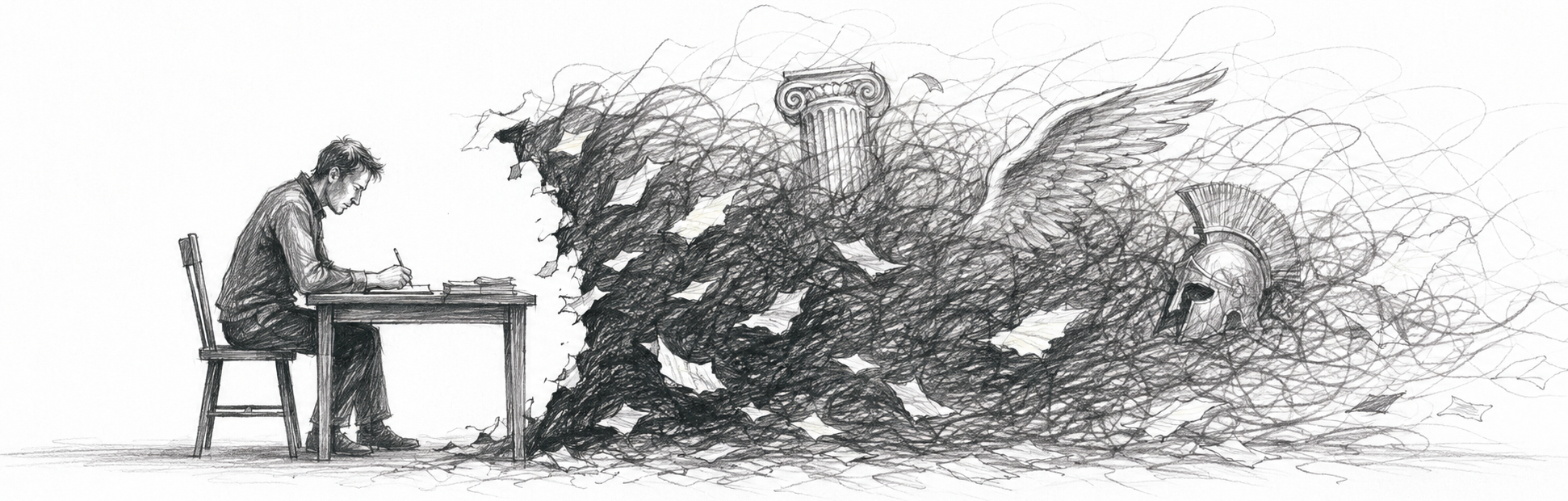
I got the urge to read the book “The War of Art,” or “The War of Art” as it’s called in the original, after watching a half‑hour video in which a young author spoke about overcoming procrastination and laziness in an interesting, though, as it seemed to me, one‑sided way. In the first few minutes, he immediately referred to the introductory words in Stephen Pressfield’s book and enthusiastically recommended it. Giving in, I followed his recommendation. Later, feeling disappointed by what I had read, I decided to look at the reviews of the book and discovered that, if not everyone, then many people had purchased and read this work based on the recommendations of one blogger or influencer or another, if you will.
Stephen Pressfield, an American writer and screenwriter, briefly and succinctly, on 180 pages that are often not even half filled with text, conveys the idea that there is a certain force between how a person lives now and how they would like to live — and its name is Resistance. Almost everything falls under Resistance. From one’s own laziness to criticism. And the recipe he offers is both simple and complex at the same time: don’t pay attention to Resistance, don’t give up, and do your work disciplinedly every day: work, endure, work.
Throughout the entire narrative, starting with explanations of what the Resistance is, who a professional is, and how to fight the Resistance, the author is thrown from one side to another. He mentions Hitler, criticizes fundamentalists, praises humanists, talks about the marines, refers to his own experience or the experience of his friends, calls out to the daughters of Zeus, and addresses the angels. Therefore, the ideas are presented rather disjointedly or seem to be inserted out of place.
Despite this, the first part of the book, and to a large extent the second part, are quite easy to read and, through a series of repeated thoughts expressed in different words, can encourage you to stop putting things off and start taking action. I felt a certain sense of inspiration as I finished the first third of the book. And even the second third, although it seemed rather monotonous and tedious by the end, was read quickly and left me with a relatively pleasant impression.
The third part, which is essentially a chopped‑up salad of mystification and esoterica, seems to have been written simply because it was necessary to somehow pad out the book’s length. And if earlier, in the first parts, Presfield asserts that
the mark of an amateur is an excessive fascination with the mystery of the nature of creativity.
then later he gives free rein to his imagination and devotes a good part of the book to the divine manifestation of creativity and art, mixing gods, angels, Greeks, yogis, and meditation in one pot. An awkward question arises: how can one follow the advice of a person who doesn’t even live up to their own words? Who is he: a professional or an amateur?